
Youths as Changemakers: Inclusive and Fair Urban Transition in Advancing Housing Solutions.
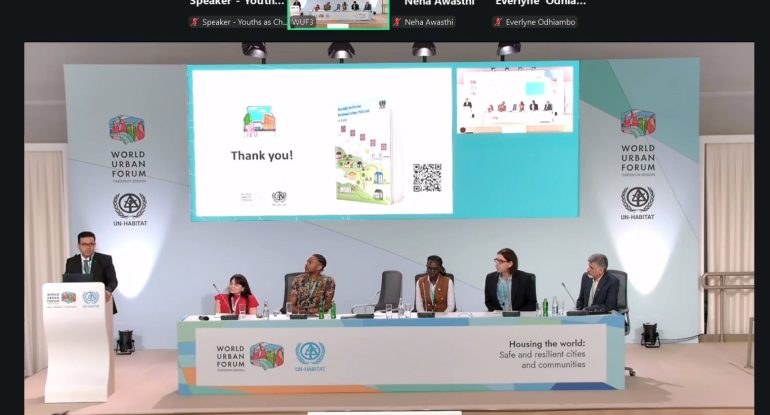
The future of our cities hinges on a critical question: Are young people merely residents of urban spaces, or are they the architects of them? At the 13th World Urban Forum (#WUF13) in Baku, Azerbaijan, a powerful answer emerged on May 22nd. SERAC-Bangladesh, in collaboration with UN-Habitat’s Policy and Legislation Section and the Human Rights and Inclusion Unit, hosted a landmark hybrid networking event titled “Youths as Changemakers: Inclusive and Fair Urban Transition in Advancing Housing Solutions.” The core message from this session was clear- to solve the global housing crisis and build genuinely fair cities, we must shift youth from the margins of casual consultation to the very center of institutional leadership.

True urban inclusion requires examining who our cities are actually built for, prompting the session to dive straight into bridging systemic gaps in urban planning. Neha Awasthi, an Urban Planning Expert at the United Nations Environment Programme (UNEP), delivered a compelling presentation on the urgent need to dismantle gender inequalities in city design. Her insights highlighted that inclusive housing and fair urban transitions cannot achieve success without addressing how gender shapes safety, accessibility, and economic opportunity in urban spaces. By recognizing these intersectional gaps, the discussion set a firm foundation for how physical spaces must adapt to serve all citizens equitably.

Representing the heartbeat of grassroots youth leadership, Amanulla bin Akter Abid, an Urban Youth Councillor from the Rajshahi City Corporation, shared the transformative impact of the Urban Youth Council (UYC) model in Bangladesh. Operating across major cities like Mymensingh, Rajshahi, Rangpur, and Narayanganj, these councils prove that when young people are given a structural platform, they don’t just participate they lead. Abid highlighted the extraordinary resilience of youth councillors during the student–public uprisings in Bangladesh. Moving far beyond traditional civic engagement, these youth leaders stepped up to provide critical humanitarian support, including setting up rapid first aid, managing urban traffic during disruptions, and actively standing guard to protect the homes and places of worship of religious minority communities. As Abid beautifully stated at the conclusion of his speech, inclusive cities are not built only with infrastructure; they are built with participation, trust, and youth leadership.

Driving home the systemic stakes of this movement, S M Shaikat, Executive Director of SERAC-Bangladesh, delivered the closing reflections by drawing from the lived experiences of Bangladesh’s youth-led urban initiatives. He emphasized a fundamental truth: cities cannot become truly livable or inclusive if young people remain outside the rooms where decisions are made. For too long, youth have been treated as a demographic to be managed rather than a powerhouse of innovation to be unlocked, and bringing them into formal governance spaces is the only way to sustain genuine urban progress.

The event ultimately served as a launchpad for action, delivering two vital urban planning tools designed to mainstream deep social inclusion and embed youth directly into governance frameworks. The first, the ‘Socially Inclusive National Urban Policies’ guide, provides a roadmap for integrating equity into macro-level state planning and housing solutions. The second, the ‘Urban Youth Council Model’, offers a scalable blueprint to formally wire youth leadership into local municipal structures. The discussions at #WUF13 remind us that inclusive housing is about more than just four walls and a roof- it is about the right to the city. By equipping youth with institutional power and actionable tools, we aren’t just planning for the future; we are letting the future build itself.