
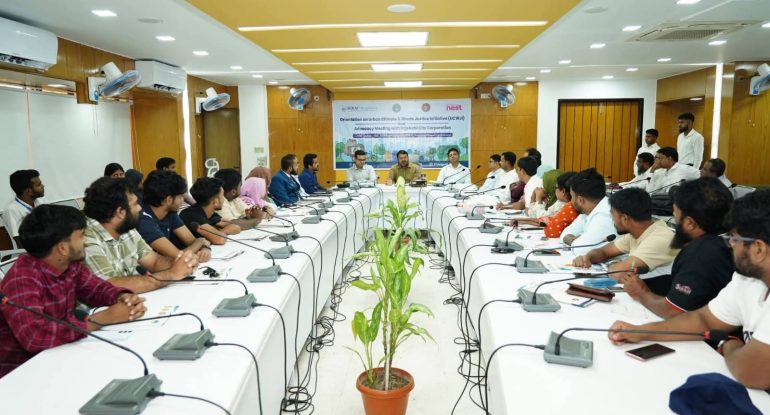
Orientation on UCWJI and Advocacy with Rajshahi City Corporation
On August 17, 2026, the Rajshahi Urban Youth Council, in collaboration with SERAC-Bangladesh, organized an orientation and advocacy meeting at the Sarit Dutta Gupta Conference Room of Rajshahi City Corporation. The meeting brought together local government officials, young leaders, urban development professionals, civil society representatives, media representatives, and other stakeholders to discuss the Council’s action plan and the Urban Climate & Waste Justice Initiative (UCWJI).
More than a project orientation, the gathering represented an important step toward strengthening youth participation in urban governance and advancing a more inclusive and just approach to urban waste management in Rajshahi.
The Rajshahi Urban Youth Council is working at the grassroots level to create a stronger platform for young people to engage with urban development, environmental challenges, waste management, and local governance. Through the Council, young people can identify challenges within their communities, engage with relevant stakeholders, and contribute to practical solutions for a more sustainable and inclusive city.
The UCWJI initiative complements this vision by placing waste justice and the rights and wellbeing of informal waste pickers at the centre of urban environmental action.

Informal waste pickers make a critical contribution to urban waste management and recycling. Every day, they help recover recyclable materials, reduce the volume of waste going to disposal sites, and contribute to environmental sustainability. Yet despite this important contribution, many informal waste pickers remain unrecognized, unprotected, and excluded from formal municipal waste management structures.
The Urban Climate & Waste Justice Initiative, being implemented on the ground by the Rajshahi Urban Youth Council, seeks to address this gap.
The short-term initiative aims to strengthen the recognition, protection, and inclusion of informal waste pickers within Rajshahi’s urban waste management system. Rather than viewing waste pickers simply as beneficiaries, the initiative recognizes them as important actors within the city’s environmental and recycling ecosystem.
One of the key components of UCWJI is ward-level mapping of informal waste pickers. Through this process, the project will identify waste pickers working across different wards, document their experiences and challenges, and develop a clearer understanding of their role within the city’s waste management system. The meeting received important institutional support from Rajshahi City Corporation.

Md. Mahafujur Rahman Riton, Administrator of Rajshahi City Corporation, attended the event as the Chief Guest.
In his remarks, Administrator Riton welcomed the activities of the Rajshahi Urban Youth Council and expressed his willingness to work in coordination with the Council. He also assured the Council of necessary support from the City Corporation, including access to a meeting room and other required facilities for conducting its meetings and activities.
This commitment is particularly significant because meaningful youth participation requires more than enthusiasm- it requires institutional space, recognition, communication, and opportunities for collaboration.
The meeting was moderated by Md. Salim Miah, Deputy Director (Program), SERAC-Bangladesh, while Lutfa Pathan, Project Manager, delivered a detailed presentation on the achievements and activities of the Rajshahi Urban Youth Council.

The meeting was chaired by Md. Rezaul Karim, Chief Executive Officer of Rajshahi City Corporation. Among the special guests were Sohel Rana, Secretary of Rajshahi City Corporation; Boni Ahsan, Urban Planner; and S M Shaikat, Executive Director of SERAC-Bangladesh.
The presence of representatives from local government, youth organizations, civil society, and urban development sectors created an opportunity for dialogue around how different stakeholders can work together to address Rajshahi’s growing urban challenges.